The Regulatory Complexity of Hospital Design in the UAE
Healthcare facility design in the UAE operates under multiple regulatory jurisdictions. DOH (Department of Health Abu Dhabi) governs facilities in Abu Dhabi, DHA (Dubai Health Authority) regulates Dubai, and MOH (Ministry of Health) oversees the Northern Emirates. Each authority maintains distinct but overlapping facility standards covering spatial requirements, clinical department specifications, and engineering system performance benchmarks.
International accreditation adds another compliance layer. Hospitals seeking JCI (Joint Commission International) or ACHSI (Australian Council on Healthcare Standards International) accreditation must meet additional facility design criteria that often exceed local minimums. For GCC operators planning cross-border facilities, CBAHI (Saudi Central Board for Accreditation of Healthcare Institutions) and NHRA (Bahrain's National Health Regulatory Authority) standards must also be considered.
The challenge for hospital developers is not just meeting these standards but anticipating regulatory evolution. DOH and DHA periodically update facility guidelines to reflect international best practices and emerging clinical technology. Engineering designs that meet current codes but lack flexibility for future updates can become regulatory liabilities within years.
Effective hospital engineering design embeds regulatory compliance into the planning process from day one. This means mapping spatial programs to DOH/DHA room size minimums, designing MEP systems that meet JCI life-safety standards, and building in infrastructure redundancy that supports both current operations and future accreditation requirements.
MEP Engineering: The Backbone of Hospital Functionality**
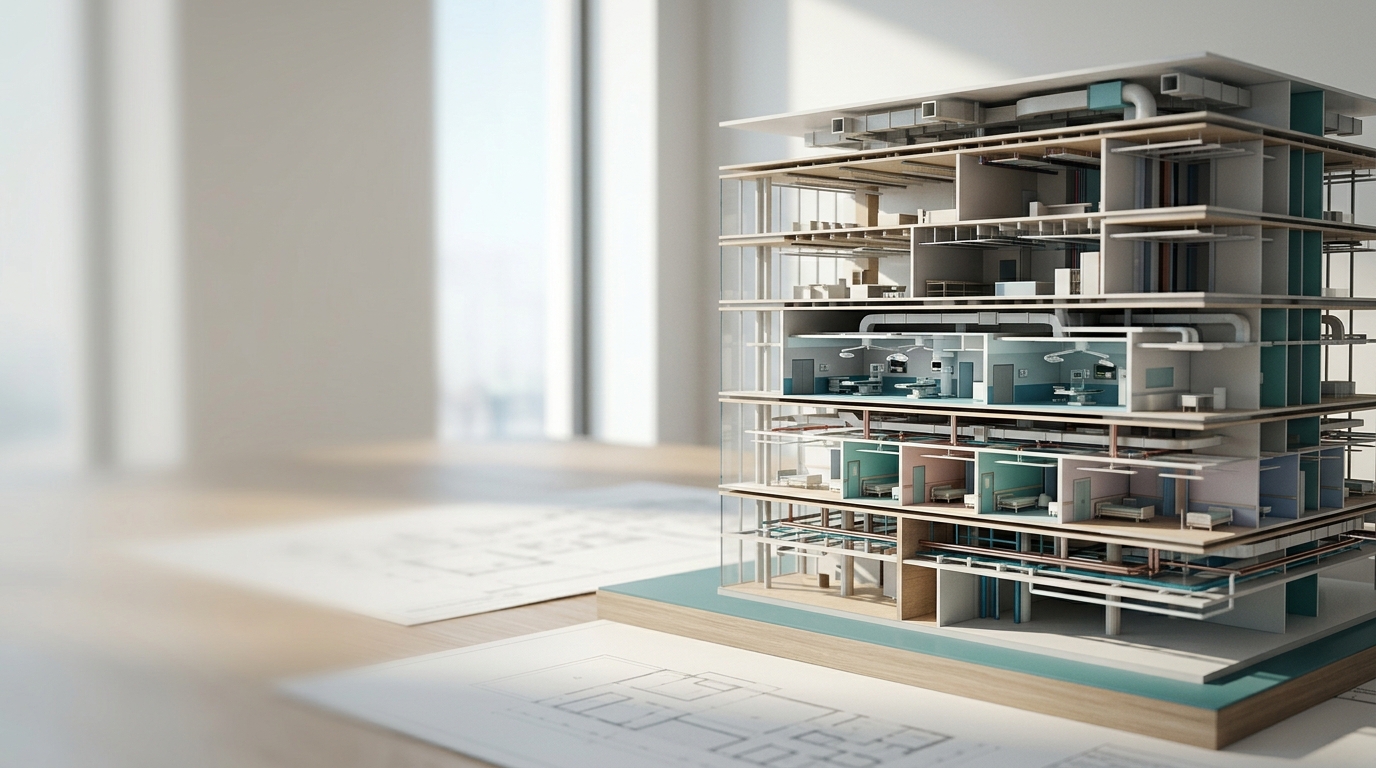
MEP (mechanical, electrical, plumbing) systems in hospitals are fundamentally different from commercial buildings. They must deliver 24/7 operational reliability, precision environmental control, and life-safety redundancy all while operating in the UAE's extreme climate conditions.
HVAC Design for Clinical Environments
Hospital HVAC systems do more than provide comfort cooling. Operating theaters require laminar airflow with positive pressure differentials to prevent airborne contamination. Isolation rooms for infectious disease management need negative pressure environments that prevent pathogen spread. Sterile processing departments demand independent humidity control to ensure instrument sterilization efficacy.
In the UAE's hot, humid climate, HVAC design must balance infection control performance with energy efficiency. Redundant chilled water plants, variable air volume systems, and heat recovery ventilation are engineering strategies that reduce operational costs without compromising clinical performance.
Medical Gas Systems
Medical gas pipeline systems (oxygen, nitrous oxide, medical air, vacuum) are life-critical infrastructure. Engineering design must ensure redundant gas sources, zone isolation valving for maintenance without service interruption, and alarm systems that alert staff to pressure drops or supply failures.
DOH and DHA standards mandate specific pipeline sizing, pressure regulation, and outlet density based on clinical department acuity. Surgical suites, intensive care units, and emergency departments have different gas flow requirements that must be calculated during design, not approximated during construction.
Emergency Power and UPS Backup
Hospitals cannot tolerate power interruptions. Emergency generators must be sized to support life-critical loads (operating theaters, ICU, emergency department) within seconds of grid failure. UPS (uninterruptible power supply) systems provide instantaneous backup for equipment that cannot tolerate even momentary outages, such as imaging systems and patient monitoring devices.
Redundancy is non-negotiable. JCI accreditation requires that generator capacity be tested under full load conditions, that fuel storage supports 72 hours of continuous operation, and that transfer switching happens automatically without clinical disruption.
Infection Control Engineering: Flow Design That Prevents HAIs
Hospital-acquired infections (HAIs) are a persistent clinical and economic burden globally. The WHO estimates that 7-10% of hospitalized patients acquire at least one infection during their stay, extending length of stay and increasing mortality risk.
Engineering design is a primary defense against HAI transmission. Infection control flow design segregates clean and contaminated pathways, ensuring that soiled materials, waste, and infectious patients do not cross paths with sterile supplies, clean linens, or immunocompromised patients.
Spatial Zoning
Clinical departments should be zoned based on contamination risk. Clean zones (operating theaters, sterile processing, pharmacy compounding) are positioned to minimize cross-traffic from contaminated zones (soiled utility rooms, waste storage, specimen labs). Airflow design reinforces this separation, with clean zones under positive pressure and contaminated zones under negative pressure.
Negative Pressure Isolation Rooms
Airborne infection isolation rooms are mandatory for hospitals treating tuberculosis, COVID-19, and other respiratory pathogens. These rooms require negative pressure relative to surrounding areas, with air exhausted to the exterior through HEPA filtration. The engineering challenge is maintaining precise pressure differentials while providing adequate ventilation rates for patient comfort and safety.
DOH and DHA standards specify minimum air changes per hour (ACH) for isolation rooms, typically 12 ACH with HEPA filtration. Engineering design must account for door openings, which temporarily disrupt pressure differentials, and ensure that pressure monitoring alarms alert staff to failures.
Sterile Processing Department Workflow
The sterile processing department (SPD) is the hospital's decontamination and sterilization hub. Engineering design must create a unidirectional workflow: contaminated instruments enter through a soiled receiving area, move through cleaning and decontamination, then proceed to sterilization, inspection, and sterile storage before distribution back to clinical departments.
HVAC design supports this workflow with negative pressure in soiled areas and positive pressure in sterile storage. Physical barriers and equipment pass-throughs prevent cross-contamination. Poor SPD design forces staff to backtrack, increasing infection risk and reducing throughput.
Clinical Workflow Optimization: Engineering for Operational Efficiency
Hospital operational efficiency is largely determined by spatial layout and departmental adjacencies. When clinical support spaces are poorly positioned, staff spend excessive time in transit, patient throughput slows, and operational costs rise.
Evidence-Based Design Principles
Evidence-based design (EBD) applies research findings on healthcare environments to improve patient outcomes and operational performance. Key EBD strategies include:
- Decentralized nursing stations: Positioning nurse workstations closer to patient rooms reduces response times and staff fatigue.
- Single-patient rooms: Reduce HAI transmission, improve patient privacy, and support family-centered care.
- Standardized room layouts: Reduce medical errors by creating predictable equipment and supply locations.
Our engineering design process incorporates EBD research alongside operational modeling to predict staff movement patterns, identify bottlenecks, and optimize departmental positioning before construction begins.
Departmental Adjacencies
Clinical departments must be positioned to support efficient patient flow and clinical collaboration. Emergency departments should have direct access to imaging (CT, X-ray) and the operating theater for trauma cases. The catheterization lab should be adjacent to the cardiac ICU for post-procedure monitoring. The pharmacy should be centrally located to minimize medication delivery distances.
These adjacencies are not architectural preferences they are operational requirements that impact patient outcomes and staff efficiency. Engineering design that ignores clinical workflow creates hospitals that are difficult to operate effectively.
Retrofitting Existing Hospitals for Regulatory Compliance
Not every hospital project is a new build. Many UAE healthcare operators face the challenge of bringing legacy facilities into compliance with updated DOH, DHA, or JCI standards without shutting down patient care operations.
Compliance retrofitting requires phased renovation planning that isolates construction zones, maintains infection control barriers, and preserves life-safety system functionality. MEP system upgrades replacing outdated HVAC equipment, adding medical gas redundancy, upgrading fire alarm systems must be sequenced to avoid service interruptions.
Space repurposing is another common challenge. Converting general patient wards to intensive care units, adding isolation capacity for infectious disease management, or expanding surgical suite capacity all require engineering design that integrates new clinical functions into existing infrastructure without compromising building performance.
Our approach to hospital retrofitting begins with a comprehensive gap analysis: comparing existing conditions to current regulatory standards, identifying critical deficiencies, and developing a phased remediation plan that aligns with operational budgets and patient care continuity requirements.
Conclusion
Engineering Design as Strategic Investment
Hospital engineering design is not a cost center. It's a strategic investment that determines regulatory compliance, operational efficiency, patient safety, and long-term financial performance.
Facilities designed with integrated MEP systems, infection control flow optimization, and clinical workflow modeling operate more efficiently, achieve faster licensing, and require fewer costly retrofits over their lifecycle. Conversely, hospitals where engineering design is treated as a technical afterthought inherit structural problems that persist for decades.
For hospital developers, investors, and operators across the UAE and GCC, the message is clear: engineering design quality is the foundation of healthcare facility success. Investing in comprehensive planning, regulatory intelligence, and multidisciplinary design collaboration delivers hospitals that meet clinical expectations, regulatory standards, and financial performance targets from day one.
If you're planning a new hospital project or evaluating compliance upgrades for an existing facility, engage engineering consultants early. The design decisions made in the planning phase will determine operational outcomes for the life of the building.





















.png)








.png)



.png)