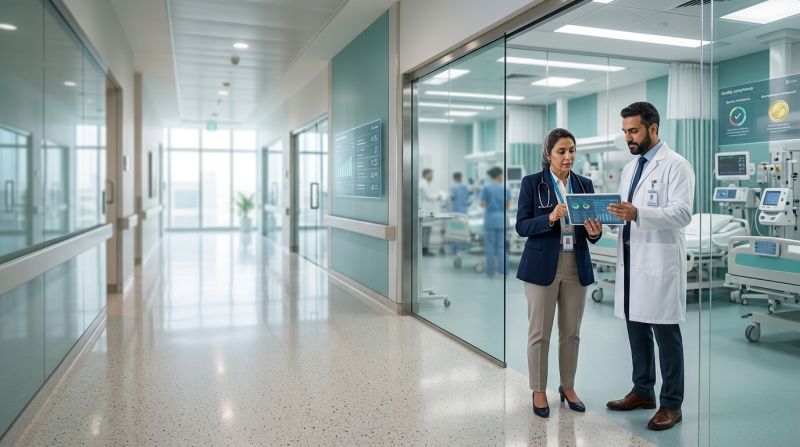
Healthcare buildings are not ordinary buildings
A standard commercial fit-out can tolerate a margin of error. A hospital cannot. Operating theatres, isolation rooms, imaging suites, and laboratories depend on engineered systems where small failures carry serious consequences. The World Health Organization is clear that safe, well-designed healthcare infrastructure is fundamental to patient safety and service quality, not a cosmetic concern.
That places unusual demands on the people managing the build. Medical gas pipelines, specialised HVAC with pressure relationships, infection control zoning, and redundant power are not features added at the end. They must be planned, supervised, and tested as core deliverables. When a project manager treats a hospital like a typical construction job, the cracks appear precisely where patients are most at risk.
The approvals problem nobody budgets for
In the UAE, construction rarely stalls because workers stop working. It stalls because approvals are not ready. The Department of Health Abu Dhabi and the Dubai Health Authority maintain detailed design, engineering, and facility standards that must be satisfied before a licence is issued. Civil Defence has its own requirements. Each of these touchpoints can halt a project that did not plan for them.
The most common and most expensive mistake is treating regulatory approval as a final step. Experienced healthcare project managers run authority submissions in parallel with the build, so that design approvals, inspections, and licensing progress alongside construction rather than after it. This single shift in sequencing routinely saves months. It is also where a generalist contractor, unfamiliar with healthcare regulation, tends to fail an owner badly.
Where budgets actually leak
Owners often assume cost overruns come from rising material prices. More often, they come from weak oversight. Unverified contractor claims, undocumented variations, and scope creep quietly erode returns long before anyone notices. Disciplined budget monitoring, where every cost is checked against an approved baseline and every payment is validated against verified work, protects capital far more effectively than aggressive price negotiation at the start.
For investors and medical groups, this matters enormously. A healthcare facility is a long-term asset, and the cost of opening late or rebuilding non-compliant work compounds quickly against projected revenue. Cost control is not administrative housekeeping. It is the protection of the entire business case.
Quality you cannot see is the quality that fails inspections
Much of what determines whether a healthcare facility passes accreditation is invisible once the walls are closed. This is why on-site supervision and engineering quality assurance are not optional. Work must be checked against approved drawings as it happens, not after handover, when corrections require demolition. International accreditation bodies such as Joint Commission International assess facilities against rigorous safety and quality standards, and a building that was supervised poorly will struggle to meet them.
Strong supervision also changes contractor behaviour. When teams know that work is inspected daily and substandard execution is rejected immediately, quality rises across the board. The owner pays for this discipline once. The alternative, paying for rework and re-inspection, is always more expensive.
Commissioning is the difference between built and licensed
A facility is not finished when construction ends. It is finished when every clinical and engineering system has been tested, validated against design intent, and documented. Commissioning is the bridge between a completed building and a licensed, operational hospital. Skipped or rushed, it becomes the single biggest barrier to opening. Done properly, with structured testing and accreditation-ready documentation, it accelerates licensing instead of obstructing it.
What good project management actually delivers
Bringing this together, the value of specialised healthcare project management is measurable. Facilities open closer to their planned dates. Budgets hold. Licensing proceeds without repeated failed inspections. Engineered systems perform from day one. For owners working across regulatory compliance, healthcare engineering, and operational readiness, it provides a single accountable partner who connects every moving part.
The UAE healthcare market rewards facilities that open well and on time. With current regulatory requirements only becoming more demanding, the owners who succeed are those who treat project management not as overhead, but as the discipline that protects their investment, their timeline, and their patients from the very first day of planning.
SUMMARY
In healthcare construction, delay and failed licensing cost more than materials. This guide explains how specialised project management protects budget, timeline, regulatory approval, and quality from planning through commissioning.